5 Signs It’s Time to Rebrand Your Business – with digital Marketing agency
Your brand is often the first impression customers have of your business. Before they speak with your team, visit your store, or enquire about your services, they’ve already formed an opinion based on your website, logo, messaging, social media presence, and overall online experience. In today’s highly competitive digital landscape, that first impression can determine whether a potential customer chooses your business or moves on to a competitor. As we move through 2026, customer expectations continue to evolve. Buyers are more informed, more selective, and more likely to research businesses online before making a purchasing decision. They expect brands to appear professional, trustworthy, consistent, and relevant across every touchpoint. Best digital marketing agency help Businesses that fail to meet these expectations risk losing valuable opportunities—even if they offer excellent products or services. This is why business rebranding has become an essential growth strategy rather than simply a cosmetic update. A successful brand should evolve alongside your business, reflecting your values, expertise, target audience, and long-term vision. What worked when you launched your company several years ago may no longer represent who you are today. Many business owners assume that rebranding your business simply means creating a new logo or choosing different colours. While visual design certainly plays an important role, a true rebrand goes much deeper. It involves refining your brand identity, improving your messaging, repositioning your business within the market, and ensuring every customer interaction supports your business goals.
Logo Update vs Complete Business Rebrand – Digital marketing agency help to do.
Many businesses wonder whether they need a simple update or a complete transformation.
| Brand Refresh | Complete Business Rebrand |
|---|---|
| Modernises existing visuals | Repositions the entire business |
| Updates logo and colours | Redefines brand identity and messaging |
| Maintains existing market perception | Targets new audiences or markets |
| Refreshes marketing assets | Updates every customer touchpoint |
| Ideal for businesses with strong brand recognition | Best for businesses experiencing significant change |
Understanding the difference is essential because investing in the right approach can have a significant impact on your long-term business branding strategy.
A well-planned rebrand can help your business:
- Build stronger customer trust
- Differentiate itself from competitors
- Improve online visibility
- Increase qualified leads
- Support expansion into new markets
- Strengthen customer loyalty
- Create a more consistent brand experience
On the other hand, delaying necessary changes can cause your business to appear outdated, disconnected from its audience, or less credible than competitors. Whether you’re a startup preparing for rapid growth, an established business entering new markets, or a local company looking to modernise, recognising the right time to evolve your brand is an important step towards long-term success. In this guide, we’ll explore the five biggest signs it’s time to rebrand your business and how a strategic rebrand can help attract more customers, improve credibility, and support long-term business growth.
What Does Rebranding Actually Mean?
Many people associate branding with logos, colours, or graphic design. While these elements are important, they represent only a small part of what your brand truly is. Your brand is the complete perception customers have of your business. It encompasses how people recognise you, what they expect from your products or services, how they feel when interacting with your company, and why they choose you over competitors. Business rebranding is the strategic process of updating or transforming this perception to better reflect your business today and where it wants to be in the future. Rather than simply changing how your business looks, rebranding aligns your visual identity, messaging, positioning, and customer experience with your business objectives.
Brand Refresh vs Complete Rebrand
Not every business needs a complete overhaul. In many cases, a carefully planned brand refresh is enough to modernise your image while maintaining the trust you’ve already built.
Brand Refresh
A brand refresh updates selected elements while preserving your core identity.
This may include:
- Modernising your logo
- Updating colours and typography
- Refreshing your website design
- Improving marketing materials
- Refining messaging
- Enhancing social media branding
A refresh works well for businesses that have strong recognition but need to appear more current.
Complete Rebrand
A complete rebrand involves redefining your entire business identity.
It often includes:
- New brand positioning
- Updated mission and values
- Revised target audience
- New messaging framework
- Complete visual identity
- Website redesign
- Marketing strategy updates
- Customer experience improvements
Businesses undergoing mergers, entering new industries, expanding internationally, or significantly changing their services often benefit from a comprehensive rebrand.
The Core Elements of a Strong Brand
Successful branding brings together multiple components to create a consistent customer experience.
1. Logo
Your logo is often the first visual representation customers recognise. It should be memorable, scalable, and aligned with your business personality. While a logo redesign can modernise your appearance, it should always support a broader branding strategy rather than exist as a standalone change.
2. Colours
Colours influence emotion and recognition. Consistent colour usage strengthens your visual identity and improves brand recall across digital and offline marketing.
3. Typography
Fonts communicate personality just as much as words do. Professional typography contributes to readability, trust, and consistency across websites, advertisements, presentations, and printed materials.
4. Website
Your website is often your most valuable marketing asset. A professional website redesign ensures visitors enjoy a seamless experience while reinforcing your brand identity. Fast loading speeds, mobile responsiveness, intuitive navigation, and compelling content all contribute to higher engagement and conversions.
5. Messaging
Clear messaging explains:
- Who you help
- What you offer
- Why customers should choose you
- What makes you different
Strong messaging removes confusion and attracts the right audience.
6. Brand Voice
Your tone of voice should remain consistent whether customers interact with your website, emails, advertisements, or social media. A professional yet approachable voice helps build familiarity and trust.
7. Customer Experience
Every interaction shapes how customers perceive your business. From your enquiry process to post-purchase support, consistent experiences reinforce your brand promise.
8. Brand Positioning
Positioning defines the unique place your business occupies in the market. Effective brand positioning answers one important question:
“Why should customers choose you instead of someone else?”
Without clear positioning, businesses often compete solely on price rather than value.
9. Marketing Assets
Everything representing your business should feel cohesive, including:
- Business cards
- Email signatures
- Social media graphics
- Sales presentations
- Brochures
- Packaging
- Advertising creatives
- Digital campaigns
Maintaining brand consistency across these touchpoints helps build recognition and credibility over time.
Branding Is More Than Design
One of the biggest misconceptions about branding is that it’s purely visual. In reality, effective branding combines strategy, communication, customer psychology, and business objectives.
A beautiful logo won’t generate leads if your messaging is unclear. Likewise, an impressive website won’t convert visitors if your positioning doesn’t resonate with your ideal audience.
Successful branding answers questions such as:
- Who are we trying to attract?
- What problems do we solve?
- How do we want customers to perceive us?
- What makes us different from competitors?
- How do we communicate our value consistently?
When these answers are reflected throughout your business branding strategy, every marketing activity becomes more effective—from SEO and content marketing to paid advertising and social media.
Ultimately, branding is about creating a memorable, trustworthy, and consistent experience that encourages customers to choose your business again and again. In the next section, we’ll explore the most common reasons businesses decide to rebrand and how these changes can unlock new opportunities for sustainable growth.
Why Businesses Rebrand
A successful brand isn’t static—it evolves alongside the business it represents. As markets change, customer expectations shift, and companies grow, a brand that once felt modern and relevant can gradually become outdated or disconnected from reality. This is one of the biggest reasons rebranding your business has become an important part of long-term success. A strategic rebrand isn’t about changing your identity for the sake of it; it’s about ensuring your business accurately reflects who you are today, where you’re heading, and why customers should choose you over the competition. Whether you’re a local service provider, an eCommerce business, a healthcare practice, or a professional services firm, there comes a time when your existing brand identity may no longer support your business goals. Let’s explore the most common reasons businesses invest in business rebranding.
1. Your Business Has Grown
Many businesses start with limited budgets, small teams, and simple branding. At the beginning, the priority is often launching quickly rather than developing a comprehensive business branding strategy. As your company grows, however, things change.
You may have:
- Expanded your service offerings
- Hired a larger team
- Opened additional locations
- Increased your prices
- Improved your expertise
- Begun working with larger clients
Yet your branding may still reflect the small business you once were rather than the established company you’ve become.
When your brand no longer represents your capabilities, customers may underestimate the value you provide. A strategic rebrand helps align your external image with your actual business maturity, making it easier to attract higher-value clients and build credibility.
2. You’re Targeting a New Audience
Businesses rarely serve the exact same audience forever. Perhaps you initially targeted budget-conscious customers but now specialise in premium services. Maybe your business has expanded from serving local customers to working nationwide, or you’ve introduced new products that appeal to an entirely different market. If your messaging, visual identity, and positioning still speak to your old audience, you’ll struggle to connect with your ideal customers.
Rebranding allows you to:
- Refine your messaging
- Adjust your tone of voice
- Update your website
- Improve your customer experience
- Better communicate your value
The result is stronger alignment between your brand and the people you want to attract.
3. Competition Has Increased
Nearly every industry has become more competitive in recent years. Customers now compare multiple businesses before making purchasing decisions. They read reviews, visit websites, explore social media, and often use AI-powered search tools to evaluate their options. If your competitors appear more professional, trustworthy, or modern—even if your products or services are superior—you could lose business simply because of perception. A strong brand helps you stand out by communicating professionalism, expertise, and value before a customer even contacts you. Rather than competing solely on price, strategic branding enables you to compete on trust, reputation, and customer experience.
4. Your Brand Feels Outdated
Design trends, technology, and customer expectations evolve constantly. A logo created ten years ago may no longer feel relevant today. Similarly, an outdated website or inconsistent marketing materials can unintentionally signal that your business hasn’t kept pace with industry changes. Signs your brand may be outdated include:
- An old-fashioned logo
- Inconsistent colours and fonts
- Low-quality marketing materials
- An outdated website
- Poor mobile experience
- Generic messaging
- Inconsistent social media branding
A thoughtful brand refresh can modernise your appearance while preserving the recognition you’ve already built.
5. Your Customer Perception Isn’t What You Want
Branding influences perception more than many business owners realise.
Ask yourself:
- Do customers immediately understand what you do?
- Do they see your business as trustworthy?
- Do they perceive you as affordable, premium, innovative, or experienced?
- Are they choosing competitors despite your better offering?
If the answers don’t align with your goals, your branding may be sending the wrong message. Rebranding gives you the opportunity to reshape customer perception by improving your:
- Messaging
- Positioning
- Visual identity
- Website
- Marketing communications
- Customer experience
When perception improves, trust often follows.
6. You’re Expanding Into New Markets
Business growth often means entering new industries, regions, or customer segments.
Perhaps you’re:
- Expanding across Australia
- Launching internationally
- Introducing new product lines
- Opening additional offices
- Moving into B2B after serving consumers
Your existing branding may no longer communicate the scale or scope of your business.
A strategic rebrand helps ensure your business appeals to a broader audience while maintaining consistency across all locations and marketing channels.
7. Mergers, Acquisitions, or Major Business Changes
Structural changes often require a refreshed identity.
For example:
- Two companies merge.
- A family business changes ownership.
- A company shifts from traditional services to digital solutions.
- A niche business expands into a full-service provider.
These transitions can create confusion if the brand doesn’t evolve alongside the business.
Rebranding helps communicate these changes clearly while maintaining customer confidence throughout the transition.
8. Digital Transformation Has Changed Customer Expectations
Today’s customers expect seamless digital experiences. Your brand is no longer limited to business cards or storefront signage. It now lives across:
- Your website
- Google Business Profile
- Social media platforms
- Email marketing
- Online reviews
- Search engines
- AI-generated search results
- Digital advertising
If these touchpoints feel inconsistent, outdated, or disconnected, customers may question your professionalism.
Modern digital branding services ensure every online interaction reinforces your brand identity and builds trust.
How Branding Impacts Business Performance
Branding isn’t just about appearance—it directly influences how customers interact with your business and whether they choose to buy from you.
Let’s look at some of the most significant ways branding contributes to long-term success.
| Business Outcome | How Strong Branding Helps |
|---|---|
| Customer Trust | Creates confidence and credibility from the first interaction. |
| Lead Generation | Attracts the right audience through clear positioning and messaging. |
| Conversion Rates | Makes it easier for prospects to choose your business over competitors. |
| Customer Loyalty | Builds familiarity and encourages repeat business. |
| Brand Recognition | Improves recall across digital and offline marketing channels. |
| Revenue Growth | Supports premium pricing and creates more sales opportunities. |
A cohesive business branding strategy also enhances every marketing activity. Whether someone finds your business through Google Search, social media, paid advertising, or word-of-mouth, a consistent brand experience increases the likelihood they’ll engage with your business.
Why Branding Matters More Than Ever in 2026
The way people discover businesses has changed dramatically. Instead of relying solely on recommendations, customers now:
- Compare businesses online before making contact.
- Read reviews across multiple platforms.
- Evaluate websites within seconds.
- Interact with brands on social media.
- Ask AI-powered search tools for recommendations.
- Expect fast, mobile-friendly digital experiences.
This means your brand identity is often working for your business long before your sales team has the chance to.
If your branding feels outdated, inconsistent, or unclear, potential customers may move on before learning about the quality of your products or services. On the other hand, businesses that invest in modern branding create stronger first impressions, improve customer confidence, and support better performance across every stage of the marketing funnel.
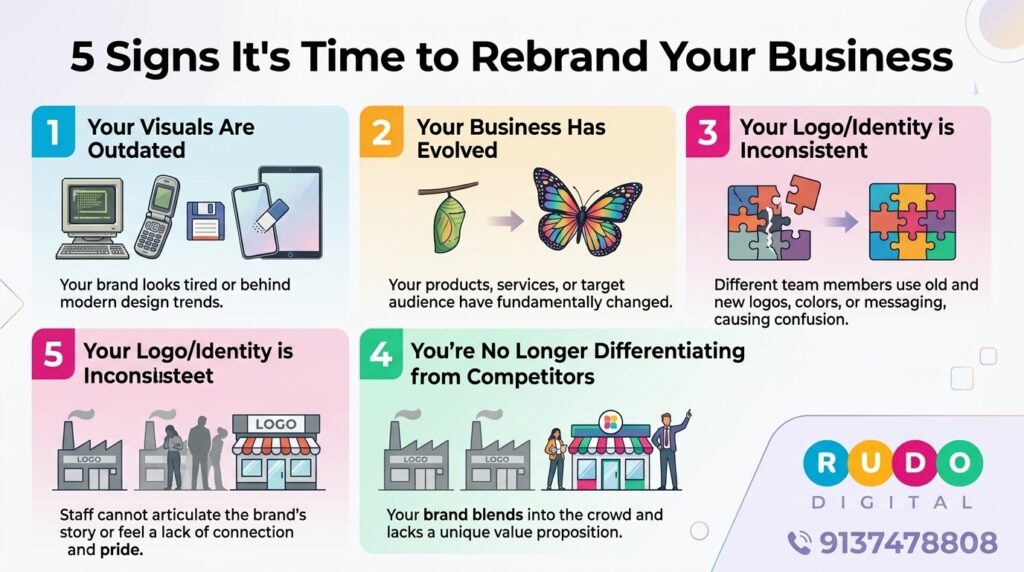
The 5 Signs It’s Time to Rebrand Your Business
Knowing why businesses rebrand is only part of the equation. The more important question is whether your business is showing signs that it’s time for a change. Some warning signs are obvious, such as an outdated logo or ageing website. Others are more subtle, including declining engagement, attracting the wrong customers, or struggling to stand out in a crowded market. In the next section, we’ll explore the 5 Signs It’s Time to Rebrand Your Business in detail and explain how recognising these indicators early can help you strengthen your brand, improve your marketing results, and position your business for sustainable growth in 2026 and beyond.
The 5 Signs It’s Time to Rebrand Your Business
Every business evolves over time, but not every brand evolves with it. As customer expectations change and competition grows, an outdated or misaligned brand can quietly hold your business back. You might have an exceptional product, outstanding customer service, and a dedicated team—yet still struggle to attract the right customers or generate consistent growth. Recognising these warning signs early allows you to make strategic improvements before your brand starts affecting your reputation or revenue.
Let’s explore the 5 Signs It’s Time to Rebrand Your Business and what each one means for your long-term success.
1 – Your Brand Looks Outdated
First impressions matter more than ever. In a matter of seconds, potential customers decide whether your business appears trustworthy, modern, and professional. If your branding hasn’t been updated in several years, it may unintentionally create the impression that your business is behind the times—even if your products or services are exceptional.
Common signs your visual identity is outdated include:
- An old or overly complex logo
- Inconsistent colours across marketing materials
- Outdated typography
- Low-quality graphics
- An ageing or slow website
- Poor mobile responsiveness
- Inconsistent social media branding
- Marketing materials that no longer reflect your business
Your visual identity communicates professionalism before a customer reads a single word on your website. A dated appearance can reduce confidence and make competitors seem like the safer choice.
Why visual identity influences buying decisions
Customers naturally associate a polished brand with quality, reliability, and expertise. An outdated design can create doubts about whether your business keeps up with industry standards.
Imagine two businesses offering identical services:
| Business A | Business B |
|---|---|
| Modern logo | Outdated logo |
| Fast, mobile-friendly website | Slow, cluttered website |
| Consistent branding | Mixed colours and fonts |
| Clear messaging | Confusing information |
Most customers will gravitate towards Business A—even before comparing prices or services.
A strategic brand refresh doesn’t necessarily mean changing everything. Sometimes updating your logo, refining your colour palette, improving typography, and investing in a professional website redesign is enough to create a stronger first impression while preserving the recognition you’ve already built.
Actionable takeaway
Ask yourself:
- Does my branding look current compared to competitors?
- Would I be proud if a prospective client visited my website today?
- Does my visual identity reflect the quality of my services?
If the answer is no, it may be time to modernise your brand.
2 – Your Business Has Changed

Businesses rarely stay the same for long. You may have launched with one service, one location, and a small customer base, but over time you’ve grown, expanded, and refined your expertise. The problem arises when your branding still reflects the business you used to be rather than the one you’ve become.
Your business may have evolved through:
- Launching new services
- Expanding into new industries
- Opening additional locations
- Serving larger clients
- Entering interstate or international markets
- Hiring specialised teams
- Moving into premium pricing
- Changing your business model
For example, a company that originally focused on website design may now offer SEO, Google Ads, branding, content marketing, and AI-powered marketing solutions. If its website and messaging still emphasise only web design, potential customers may never realise the full scope of its expertise.
Why this matters
Your brand identity should accurately communicate:
- What you do
- Who you help
- Why you’re different
- What value you provide
- Where your business is heading
When your branding fails to reflect your current capabilities, customers may underestimate your expertise or overlook services they would happily purchase.
Aligning branding with growth
As your business grows, your business branding strategy should evolve alongside it.
This may involve:
- Updating your messaging
- Refining your positioning
- Refreshing your website
- Improving your service pages
- Creating new brand guidelines
- Strengthening your customer experience
A strategic rebrand ensures your external image reflects your internal growth.
Actionable takeaway
Review your website and marketing materials with fresh eyes.
Do they accurately represent the business you operate today—not the one you launched years ago?
If not, rebranding your business could help bridge that gap.
3 – You’re Not Attracting the Right Customers

Generating leads is important, but attracting the right leads is what drives sustainable growth. Many businesses mistakenly assume their marketing isn’t working when, in reality, their branding and positioning are attracting the wrong audience.
Common symptoms include:
- Frequent price shoppers
- Low-quality enquiries
- Poor conversion rates
- Customers misunderstanding your services
- Constantly competing on price
- High enquiry volumes with few sales
Often, these issues stem from weak messaging rather than poor marketing.
Positioning makes the difference
Effective brand positioning clearly communicates:
- Who your services are for
- What problems you solve
- Why customers should choose you
- What makes your business unique
Without strong positioning, your business risks blending into a crowded market.
Instead of saying:
“We provide digital marketing.” A well-positioned brand might communicate: “We help Australian small businesses generate more qualified leads through data-driven digital marketing strategies.” The second statement immediately tells prospective customers who the business serves and the outcome they can expect.
Strong branding attracts better customers
When your branding reflects your expertise and communicates your value clearly, you naturally attract customers who:
- Appreciate quality
- Understand your pricing
- Need your specific services
- Are more likely to convert
- Become long-term clients
This reduces wasted marketing spend and improves overall return on investment.
Actionable takeaway
Ask yourself:
- Are we attracting our ideal customers?
- Do prospects understand our value before contacting us?
- Does our messaging differentiate us from competitors?
If not, refining your positioning could transform the quality of your enquiries.
4 – Your Competitors Stand Out More Than You

In almost every industry, competition has intensified.
Customers are comparing multiple businesses before making a decision, often evaluating:
- Websites
- Reviews
- Social media
- Google Business Profiles
- Search rankings
- Online reputation
- Content quality
- Overall professionalism
If competitors consistently appear more credible or memorable, your business may struggle to gain attention—even when your services are superior.
Why customer perception matters
People don’t always buy the best product.
They often buy from the brand they trust the most.
Professional branding helps establish that trust by creating consistency across every customer touchpoint.
This includes:
- Website design
- Brand messaging
- Social media
- Advertising
- Email communications
- Sales presentations
- Customer support
Together, these elements shape customer perception, influencing whether potential clients view your business as established, reliable, and worth investing in.
Branding creates competitive advantage
Strong branding allows businesses to compete on value rather than price.
Instead of asking:
“Who’s the cheapest?”
Customers begin asking:
“Who seems most capable of solving my problem?”
That’s a powerful shift—and it’s exactly what strategic branding aims to achieve.
Actionable takeaway
Compare your business with your top five competitors.
Consider:
- Which website feels more professional?
- Which brand is easier to remember?
- Which business appears more trustworthy?
- Which company communicates its value most clearly?
If competitors consistently outperform you in these areas, it may be time to strengthen your brand.
5 – Your Marketing Isn’t Delivering Results

Many businesses assume declining marketing performance is caused by ineffective campaigns. In reality, weak branding often undermines even the best marketing strategies. You can invest heavily in SEO, Google Ads, social media, and content marketing—but if customers don’t trust your brand after clicking through, they’ll leave without converting.
Signs your marketing may be affected by branding
- Low website engagement
- High bounce rates
- Poor conversion rates
- Weak Google Ads performance
- Rising customer acquisition costs
- Low organic search visibility
- Declining social media engagement
- Limited brand recognition
Marketing attracts visitors.
Branding convinces them to stay.
How branding improves digital marketing performance
A strong brand enhances every marketing channel by creating consistency and trust.
| Marketing Channel | How Strong Branding Helps |
|---|---|
| SEO | Improves user engagement, trust, and branded searches. |
| Google Ads | Increases click-through rates and landing page conversions. |
| Social Media | Creates recognisable, consistent content. |
| Email Marketing | Builds familiarity and encourages repeat engagement. |
| Content Marketing | Reinforces authority and expertise. |
| Website | Improves user experience and conversion rates. |
When branding and marketing strategy work together, businesses often experience stronger performance across the entire customer journey—from awareness to enquiry to long-term loyalty.
Actionable takeaway
If your marketing campaigns generate traffic but fail to convert visitors into customers, don’t immediately assume the problem is your advertising budget.
Take a closer look at your branding, messaging, website, and customer experience. Often, improving these foundational elements can significantly increase the effectiveness of your existing marketing efforts.
Key Takeaway: Is It Time to Rebrand?
If you recognised one or more of these warning signs, your business may be ready for a strategic rebrand.
Here’s a quick self-assessment:
| Question | Yes / No |
|---|---|
| Does your brand look outdated compared to competitors? | ☐ |
| Has your business changed significantly since your branding was created? | ☐ |
| Are you attracting the wrong type of customers? | ☐ |
| Do competitors stand out more than your business? | ☐ |
| Are your marketing campaigns underperforming despite continued investment? | ☐ |
If you answered “Yes” to several of these questions, it’s worth considering whether your current branding is helping—or hindering—your growth.
A thoughtful rebrand is about much more than aesthetics. It’s an opportunity to refine your brand identity, strengthen your brand positioning, improve customer perception, and create a foundation for sustainable growth.
In the next section, we’ll explore the key benefits of rebranding your business, from building trust and strengthening brand recognition to attracting more qualified leads, improving customer engagement, increasing conversions, and unlocking new growth opportunities. A strategic rebrand helps your business stay relevant in a competitive market and creates a stronger connection with your target audience. At Rudo Digital, we help businesses transform their brand identity through data-driven digital marketing strategies, enabling them to stand out alongside leading agencies such as Web Grow Digital and other established competitors while building a lasting, memorable brand presence.
5. Benefits of Rebranding Your Business
Rebranding is often viewed as a creative project, but its real value lies in the business outcomes it delivers. A well-executed rebrand can strengthen your market position, improve customer trust, and make every marketing dollar work harder. When your brand identity aligns with your business goals, customers gain confidence in your products or services, your team communicates more consistently, and your marketing becomes more effective. Here are some of the biggest benefits of investing in business rebranding.
1. Build Greater Customer Trust
Trust is one of the most important factors influencing purchasing decisions. Customers are more likely to choose businesses that appear professional, reliable, and consistent.
An updated brand helps create a strong first impression through:
- Professional visual identity
- Clear messaging
- Modern website
- Consistent communication
- High-quality customer experience
When customers trust your business, they’re more comfortable making enquiries, requesting quotes, or completing purchases.
2. Improve Brand Recognition
Consistency helps people remember your business.
Using the same colours, typography, messaging, imagery, and tone of voice across every touchpoint makes your brand easier to recognise.
Strong brand consistency leads to:
- Better recall
- Increased familiarity
- Greater credibility
- Stronger long-term relationships
Whether customers discover you through Google, social media, referrals, or AI-powered search, a cohesive brand creates a memorable experience.
3. Attract More Qualified Leads
One of the biggest advantages of rebranding your business is attracting customers who are genuinely looking for what you offer.
When your messaging clearly communicates:
- Who you help
- What you specialise in
- Your unique value
- Your expertise
…you naturally filter out poor-fit enquiries while attracting higher-quality prospects.
This often results in:
- Better conversion rates
- Less time spent on unsuitable leads
- Higher-value projects
- Improved customer satisfaction
4. Strengthen Customer Loyalty
A strong brand isn’t just about winning new customers—it’s also about keeping existing ones.
Customers who feel connected to your brand are more likely to:
- Purchase again
- Recommend your business
- Leave positive reviews
- Engage with your content
- Become long-term advocates
Brand loyalty reduces customer acquisition costs and supports sustainable growth.
5. Increase Conversion Rates
Your website may receive thousands of visitors every month, but traffic alone doesn’t generate revenue.
Branding influences what happens after someone lands on your website.
A strategic rebrand improves:
- Website usability
- Customer confidence
- Clear calls-to-action
- Consistent messaging
- Professional design
- User experience
Together, these improvements encourage visitors to take the next step, whether that’s making an enquiry, booking a consultation, or completing a purchase.
6. Improve SEO Performance
Branding and SEO work hand in hand.
A well-branded website often performs better because users are more likely to:
- Stay longer
- Visit multiple pages
- Return later
- Share content
- Search for your business by name
These positive engagement signals support stronger search engine performance over time.
A rebrand also provides an excellent opportunity to:
- Refresh website content
- Improve page structure
- Optimise keywords
- Enhance internal linking
- Update metadata
- Improve mobile performance
Together, these improvements strengthen both user experience and organic visibility.
7. Improve Paid Advertising Performance
Paid advertising is most effective when it directs users to a trustworthy, relevant destination.
Even the best Google Ads or Meta Ads campaign can underperform if visitors arrive on a website that looks outdated or inconsistent.
A modern brand helps improve:
- Click-through rates
- Landing page engagement
- Conversion rates
- Quality Score
- Return on ad spend (ROAS)
Better branding often means better results from the same advertising budget.
8. Increase Website Engagement
Your website is often the centre of your digital presence.
An updated website redesign improves:
- Mobile responsiveness
- Navigation
- Page speed
- Accessibility
- Content readability
- Visual appeal
When visitors enjoy a better experience, they’re more likely to explore your services and contact your business.
9. Increase Perceived Value
Customers don’t evaluate businesses solely based on price—they evaluate value.
Professional branding helps position your business as:
- Experienced
- Premium
- Innovative
- Reliable
- Established
This stronger perception often allows businesses to compete on expertise rather than discounts.
Instead of asking, “Why are you more expensive?” customers begin asking, “How soon can we get started?”
10. Unlock New Revenue Opportunities
A strategic rebrand creates opportunities for long-term growth by making it easier to:
- Launch new services
- Enter new markets
- Target premium customers
- Expand geographically
- Increase referrals
- Form strategic partnerships
In other words, branding becomes an investment in future business growth rather than simply a design expense.
Summary: How Rebranding Supports Business Growth
| Benefit | Business Impact |
|---|---|
| Stronger trust | Higher customer confidence |
| Better recognition | Improved brand recall |
| Qualified leads | Better conversion opportunities |
| Customer loyalty | More repeat business |
| Higher conversions | Increased sales |
| Better SEO | More organic traffic |
| Improved advertising | Greater marketing ROI |
| Better website engagement | Lower bounce rates |
| Higher perceived value | Ability to command premium pricing |
| Business growth | More revenue opportunities |
The businesses that consistently grow aren’t always those with the biggest budgets—they’re often the ones with the clearest positioning, the strongest customer experience, and a brand that inspires confidence.
6. Common Rebranding Mistakes to Avoid
While rebranding offers significant opportunities, it’s not without risks. A poorly planned rebrand can confuse customers, weaken brand recognition, and reduce the effectiveness of your marketing efforts.The key is to approach business rebranding strategically rather than making changes based solely on trends or personal preferences. Here are some of the most common mistakes businesses should avoid.
1. Rebranding Without Research
One of the biggest mistakes is redesigning your brand without understanding your audience or market.
Before making any changes, ask:
- What do customers currently think about our brand?
- What are our competitors doing well?
- What makes our business unique?
- What do customers value most?
Research provides the insights needed to build a brand that resonates with your ideal audience.
2. Ignoring Customer Perception
Your brand exists in the minds of your customers—not just within your business.
If you ignore customer feedback during the rebranding process, you risk creating a brand that doesn’t reflect their expectations.
Gather insights through:
- Customer surveys
- Online reviews
- Sales conversations
- Support enquiries
- Social media feedback
These insights can guide smarter branding decisions.
3. Changing Everything at Once
Not every business needs a complete transformation.
Changing your:
- Logo
- Colours
- Website
- Messaging
- Business name
- Product names
…all at once can confuse existing customers.
In many cases, a strategic brand refresh delivers better results while maintaining valuable brand recognition.
4. Copying Competitors
It’s natural to admire successful competitors, but copying their branding rarely leads to long-term success.
Instead of blending in, focus on your unique strengths.
Ask yourself:
- What makes our business different?
- Why do customers choose us?
- What experience can only we provide?
Authenticity creates stronger differentiation than imitation.
5. Inconsistent Implementation
A rebrand should be reflected consistently across every customer touchpoint.
This includes:
- Website
- Social media
- Email signatures
- Business cards
- Sales presentations
- Packaging
- Advertising
- Signage
Even small inconsistencies can reduce professionalism and weaken brand consistency.
6. Forgetting SEO
Many businesses redesign their website without considering SEO. Common mistakes include:
- Changing URLs without redirects
- Removing high-performing content
- Ignoring keyword optimisation
- Losing backlinks
- Forgetting metadata
To protect your search rankings, SEO should be part of your rebranding strategy from day one.
7. Neglecting Website Updates
A new logo on an old website creates an inconsistent experience. Your website redesign should align with your updated branding by improving:
- Navigation
- User experience
- Mobile responsiveness
- Page speed
- Accessibility
- Conversion pathways
A modern website reinforces your new brand and supports better marketing performance.
8. Poor Communication
Customers appreciate transparency.
If your rebrand includes noticeable changes, explain:
- Why you’re evolving
- What’s changing
- What’s staying the same
- How the changes benefit customers
Clear communication helps maintain trust and reduces confusion.
Rebranding Checklist
Before launching your new brand, ensure you’ve completed the following:
- Conducted customer and competitor research
- Defined your brand positioning
- Updated your visual identity
- Refreshed your messaging
- Redesigned your website
- Protected your SEO
- Updated all marketing materials
- Trained your team on the new brand
- Communicated changes to customers
- Planned a consistent launch across all channels
Avoiding these common mistakes will help ensure your rebrand strengthens your reputation rather than disrupting it.
Final Thoughts
Your brand should grow alongside your business. If it no longer reflects your expertise, connects with your target audience, or supports your marketing efforts, it may be time for a strategic rebrand. A strong brand identity builds trust, improves customer perception, and creates a solid foundation for long-term business growth.
RUDO Digital helps businesses build memorable brands that not only look professional but also generate more traffic, qualified leads, and long-term business growth.